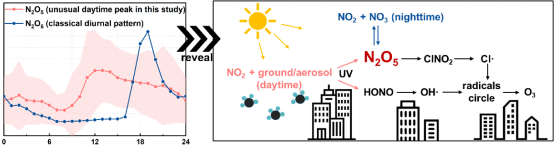
Dinitrogen pentoxide (N2O5) is a key reactive nitrogen species that plays a significant role in atmospheric nitrogen cycling. While N2O5 is thought to form primarily through nocturnal NO2 and NO3 reactions, our study observed persistent and unusual diurnal patterns of N2O5 concentrations with distinct daytime peaks in urban Xiamen, southeastern China. Linear regression analysis showed that the unknown daytime N2O5 production rates were closely correlated with proxies for heterogeneous chemical pathways. An explainable machine learning analysis revealed that the laboratory-characterized pathways including UV-induced heterogeneous processes of N2O4 and photocatalytic oxidation of NO2 by TiO2 on surfaces were key factors explaining the unknown N2O5 sources. A chemical box model indicated that these heterogeneous reactions significantly contributed to daytime N2O5 formation and led to a 12.6% increase in net O3 production. This study highlights the significance of heterogeneous chemical processes in urban N2O5 formation, and underscores their non-negligible impacts on photochemical pollution.