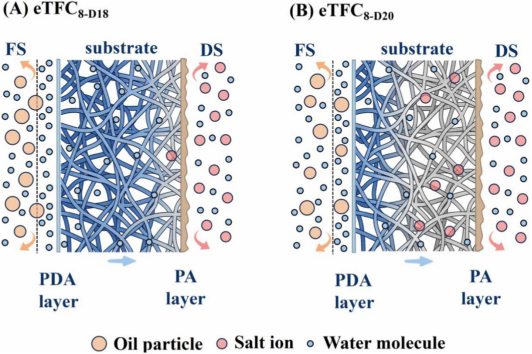
Thin-film composite forward osmosis (TFC-FO) membranes supported by electrospun substrates offer high water flux by reducing transport resistance and alleviating internal concentration polarization (ICP). However, their application in pressure-retarded osmosis (PRO) for emulsified oily wastewater treatment remains constrained by severe fouling on the bottom surface of the porous substrate. Herein, we present a hierarchical double-skinned eTFC-FO membrane that integrates a hydrophilic polydopamine (PDA) bottom layer, a gradient-hydrophilic substrate, and a highly selective polyamide (PA) top layer. The PDA bottom layer, formed without substrate prewetting, narrows the surface pore size and imparts intrinsic antifouling properties. Meanwhile, controlled dopamine diffusion creates a gradient hydrophilicity across the substrate, which not only facilitates rapid water transport and mitigates solute accumulation, but also synergistically enhances fouling resistance. Crucially, the moderately hydrophilic top surface facilitates the formation of a highly cross-linked PA layer with fewer defects. The optimized membrane (eTFC8-D18) achieves an initial PRO-mode water flux exceeding 62 LMH, with a flux decline of ~30% and a flux recovery ratio above 90% after two cycles of emulsified oil/water filtration. This work demonstrates that the synergistic hierarchical design provides a viable pathway for mitigating the fouling of eTFC membranes in PRO-mode treatment of emulsified oily wastewater.