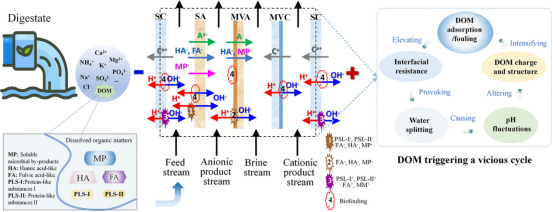
The selective recovery of nutrients from anaerobic digestate via selectrodialysis (SED) is hampered by dissolved organic matter (DOM) which induced membrane fouling. This study systematically investigates the impact of real digestate DOM on the performance of standard (SA, SC) and monovalent-selective (MVA, MVC) ion-exchange membranes during SED. Results indicated that DOM presence increased energy consumption by 10-15% and notably reduced the current efficiency of anions. Fluorescence excitation-emission matrix analysis revealed that humic acid-like and soluble microbial by-product-like substances were the primary foulants. Anion-exchange membranes, particularly SA, were most susceptible to fouling, evidenced by significant surface morphological changes and increased hydrophobicity. DOM fouling was found to promote water splitting at the membrane surface, leading to substantial pH fluctuations in the process streams, which further influenced DOM speciation and transport. Interestingly, monovalent-selective membranes, especially MVA, exhibited superior antifouling properties compared to their standard counterparts. Furthermore, biofouling was identified as a key factor contributing to the selective loss of ammonium nitrogen. This study provides critical insights into the multifaceted mechanisms of DOM fouling in SED and underscores the importance of membrane selection and process control for the efficient nutrient recovery from organic-rich waste streams.