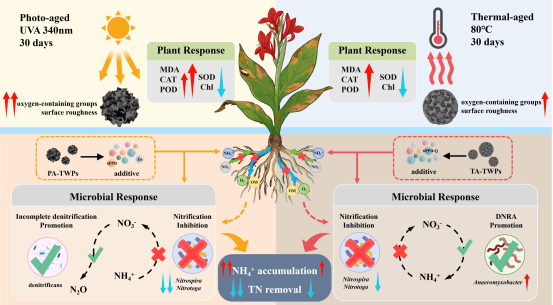
The nitrogen removal performance of constructed wetlands (CWs) is facing potential threats from tire wear particles (TWPs). However, the impact and potential mechanism of their continuous accumulation remain unclear, especially the comparison of different aging pathways. Therefore, this study constructed CWs microcosm to compare the effects of photo-aged (PA) and thermal-aged (TA) TWPs on its nitrogen removal performance and explore its main mechanism pathways. The results showed that both mainly reduced the TN removal rate by affecting NH4+-N removal, and PA-TWPs had a more significant reduction than TA-TWPs. Both pathways alter the physicochemical properties of TWPs and additive accumulation in CWs, thereby affecting nitrogen removal performance through plant oxidative stress and microbial nitrogen transformation. However, their dominant mechanisms differ. PA-TWPs group synergistically reduced the TN removal performance by inducing plant oxidative stress and inhibiting the abundance of nitrifying bacteria (Nitrospira, Candidatus Nitrotoga). TA-TWPs group not only inhibited the abundance of the aforementioned nitrifying bacteria, but also indirectly suppressed TN removal performance by affecting nitrogen removal pathway of plants, and promoted the abundance of dissimilatory nitrate reduction to ammonium bacteria Anaeromyxobacter, resulting in the accumulation of NH4+. This study emphasized the microscopic mechanism behind the differences in nitrogen removal performance driven by TWPs from different aging pathways, providing a theoretical basis and practical direction for assessing their ecological risks and optimizing CWs nitrogen removal performance.