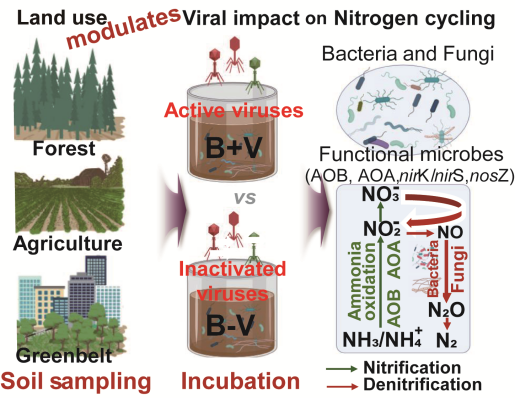
Land use and soil viruses affect microbial communities and nitrogen cycling. However, how land use modulates viral effects on soil microbial communities, nitrification, and denitrification remains poorly understood. Here, we constructed a microcosm system using sterilized forest (FR), greenbelt (GB), and agricultural (AG) soils inoculated with microbial suspensions and either active or inactivated viral suspensions for 14 or 56 days. The addition of active viruses increased bacterial abundance and altered the composition of bacterial and fungal communities across land uses. Potential nitrification rate (0.013 to 4.17 mg NO3--N kg⁻¹ dry soil h⁻¹) decreased in forest and agricultural soils but increased in greenbelt soil with active viral addition. Potential denitrification rate and N₂O emission rates (0.015 to 1.53 μg N g⁻¹ dry soil h⁻¹) increased in forest soil, whereas potential denitrification rate decreased in greenbelt soil with active viral addition compared with inactivated viral addition. Isotope-based source partitioning suggested that active viral addition altered the pathways of N₂O production in forest and agricultural soils. PLS-PM results showed that viral effects on soil nitrogen cycling indicators were associated with land-use-dependent soil nutrient levels, microbial communities, and VLPs. The ANOVA further showed that responses of nitrogen-cycling indicators to viral addition depended on soil type and incubation time under the microcosm conditions. Overall, this study provides initial microcosm evidence that active viral addition was associated with changes in potential nitrification rate, potential denitrification rate, and N₂O emission rate in soil with different land uses.