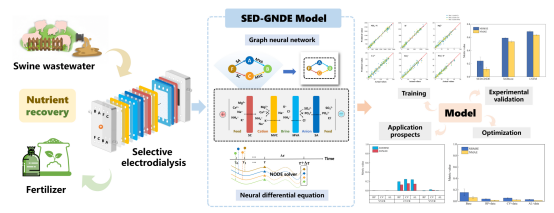
Selective electrodialysis (SED) is a promising method for recovering nutrient ions, such as phosphate, ammonium, sulfate and potassium, from wastewater. However, nutrient recovery by SED is an intricate process governed by multi-dimensional parameters, including wastewater characteristics, membrane properties and operating conditions, making the recovery process complex and challenging to predict. In this study, a novel model, termed SED-GNDE, was developed by integrating the membrane stack structure with graph neural networks and incorporating neural ordinary differential equations to capture ion transport behavior, so as to realize the prediction of nutrient ions in the SED process. Different sets of experiments were designed and carried out to validate and optimize the model. The results showed that SED-GNDE exhibited better generalization performance than traditional machine learning models. Based on a comparison among different data utilization strategies (random partitioning, cross-validation and active learning), the active learning strategy showed higher data efficiency and achieved superior generalization performance. The final iterative model demonstrated strong predictive performance, with NRMSE and NMAE values of 0.032 and 0.014, respectively. Furthermore, several operational modes were conducted to evaluate the disturbance rejection performance of the model, which indicated that SED-GNDE remained robust under dynamic operating modes involving variable voltage and coordinated voltage-flow regulation. These results suggested that SED-GNDE may serve as a useful foundational module within a model predictive control framework for dynamic electrodialysis operation in nutrient recovery.