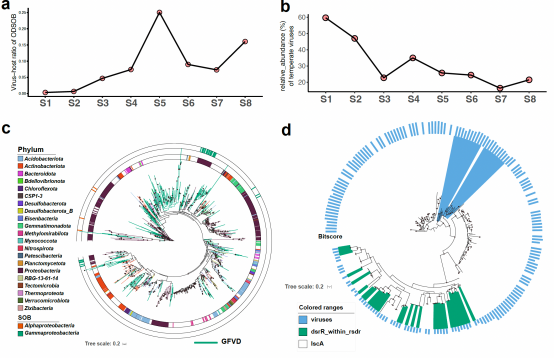
Glacier forelands undergo a transition from oligotrophic to eutrophic conditions during primary succession. Reduced sulfur compounds may serve as an energy source for early microbial colonizers, yet the sulfur oxidation potential and key taxa remain largely unknown. Here, we perform a multi omics survey across a 130 year chronosequence on the Tibetan Plateau. Glacial retreat profoundly reshapes both viral communities (61,394 viral operational taxonomic units, vOTUs) and microbial communities (404 metagenome assembled genomes, MAGs). Notably, Oxidative Dissimilatory sulfite reductase (Dsr) operon encoding Sulfur Oxidizing Bacteria (ODSOB) were specifically enriched within the first 1–5 years after retreat. Their associated viruses predominantly follow a “piggyback the winner” strategy, influencing host cold shock protein evolution and potentially modulating sulfur oxidation via iron sulfur (Fe S) cluster assembly. Metatranscriptomics reveals elevated expression of the oxidative Dsr operon and Form I ribulose 1,5 bisphosphate carboxylase/oxygenase (RubisCO) in early stages, coinciding with higher sulfate, sulfite, sulfide, and dissolved inorganic carbon (DIC) to dissolved carbon ratios compared to later stages. These findings indicate that ODSOB support DIC fixation and sulfide detoxification during early ecosystem development. Collectively, this study uncovers the eco evolutionary dynamics between viruses and microbes in developing ecosystems and provides genomic and functional evidence for ODSOB as key drivers of soil formation and primary succession in glacial forelands.